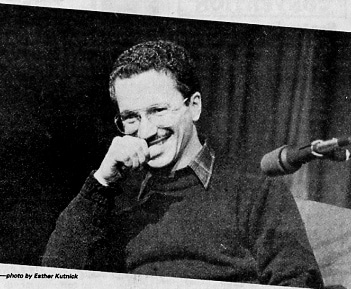
Article by Bob Hershon originally published in Jazziz Magazine Toru Takemitsu passed away shortly (February 1996) after the release of the film Music for The Movies:Toru Takemitsu.
“THE CONFLICTS, VIOLENCE, AS WELL as the erotic elements in cinema are what interest me.”
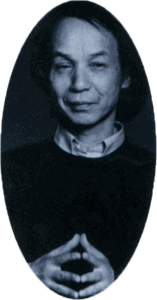
The artist quoted above is not American cinema’s newest infant terrible Quentin Tarantino but Japanese composer Toru Takemitsu. Takemitsu is the latest recipient of classical music’s richest and most democratic honor, the Grawemeyer award, and he is also the subject of a new film by Charlotte Zwerin(who also made the Straight, No Chaser documentary about Thelonious Monk).
Music for The Movies:Takemitsu chronicles the composer’s revolutionary impact on the Japanese film industry, as well as his historic pairings with directors like Akira Kurosawa (Ran) and Nagisa Oshima (Empire of Passion). Takemitsu’s career began at the end of World War II. He was the first composer to use native instruments (such as the biwa) in a Japanese film score, and his aesthetic was often at odds with the existing culture, then inundated by Western influence. When Stravinsky toured Japan after the war in search of inspirational new works, the authorities excluded Takemitsu’s music because they thought it too odd. Through a bureaucratic snafu, Stravinsky heard Takemitsu anyway, and he praised the composer’s work above all others. Official opinion changed, and Takemitsu became the preeminent composer in his country.
The composer of “November Steps” and, more recently, the award-winning “Fantasma Cantos,” Takemitsu has always railed against the forces which separate composers into genres or dis-enfranchise creators from the application of their work. “Scoring for the movies is like getting a passport to freedom,” he says. “Writing music for film is a cooperative effort that counters the self-absorption that can occur when one creates alone, where a composer can start obsessing about his creation and his 10 fingers.
I’m often asked to make a distinction between my film scores and my more ‘serious’ work, like ‘NovemberSteps.’ I say, ‘Millions of people saw and heard the work I did on Teshigahara’s Woman in the Dunes and Kobayashi’s Kwaidan. You tell me that’s not serious?”
Clarinetist Richard Stoltzman, who nominated Takemitsu for the Grawemeyer award, outlines the special position the composer occupies in the Japanese film world: “In the film [Takemitsu] you can see the level of respect in which he is held by directors. Many of them are talking for the first time on camera, describing Toni as a friend as well as a collaborator.” Stoltzman continues, “I think the high ideal of any art form is to combine with the other arts and make something more significant. Rather than compartmentalize his efforts, Toni becomes a co-conspirator with the director. His input is not just musical. He is there from the beginning to the end of the film. As Masahiro Shinoda made clear in [Takemitsu], it’s his artistic instinct which is so valued. That’s why Shinoda re-cut his film at Toni’s suggestion.” Takemitsu anticipated the same type of cooperation while working on the American film Rising Sun, but he was rudely awakened to Hollywood’s power politics when his score and whatever control he may have had was taken from him. All director Phil Kaufman could offer was his regrets that the process was beyond even his control. As a result, Takemitsu’s most widely exposed effort bears little resemblance to his original intent.
Conceptually, Takemitsu views all sounds in the movie, whether the cracking of a board or a passage for strings, as within the province of the score. Unlike the foley (sound effects) artists who sync sound to the action, Takemitsu’s “musical” effects are often dislocated a beat from the action on the screen. His compositions for the medium are much more sparse and, like his orchestral works, make use of extended silences to frame and delineate the sound.
“In most movies there is too much music,” says Takemitsu. “It draws attention away from what’s on the screen, which should tell the story by itself. To create suspense or accent the action, you have to sneak up on an audience, not musically cue them that the monster is coming, like in Jaws. I make an effort to electronically alter natural sounds so as not to duplicate what one expects from the action on the screen. Rather I try to create an impression of the sound to enhance the atmosphere.”
Takemitsu’s love for jazz, evinced by his Dixieland theme on his latest film, can be traced to his post-war years, where the Armed Forces radio filled the Japanese airwaves with big band music from “V-discs. “The latest release of his compositions, Richard Stoltzman’s Cantos on RCA Red Seal, includes “Waves,” which marries improvisation to modern classical form in a truly unique manner. His affection for the form was, as Stoltzman relates, a direct outgrowth of his interest in one of America’s greatest composers.
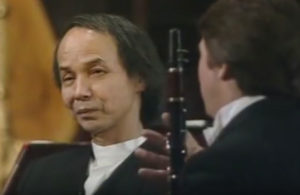
Click picture to view Richard Stolzman introducing and performing Takemitsu’s Fantasma Cantos
“Some years ago,” says Stoltzman, “despite the fact he received no formal training in music, Tom was awarded a Guggenheim Fellowship. When asked who he wished to study orchestration with, he named Duke Ellington, and was subsequently informed that was an inappropriate choice. It’s unfortunate, because he shares many abilities with Ellington, like the uncanny knack for recognizing and writing for the special qualities of his soloists.” “Fantasma Cantos,” for instance, has a passage where Ellingtonian muted chords in the winds and harmonics in the strings are sustaining very softly while the clarinet plays a line with the kind of purity you hear in the opening of “In a Sentimental Mood.” To paraphrase Stoltzman, Takemitsu’s music mirrors both a spirit which would disturb no blade of grass and a will which has persevered against one of the world’s most powerful industries. As Takemitsu so obviously shows, first and foremost, the duty of any sound-track is to serve the film. It’s therefore a happy accident when a film score will stand on its own as a listenable and somewhat coherent CD. Aware that a soundtrack can breathe life into a film project or financial equity, record companies are now putting all their digital wizardry into maximizing the exceptional sonic imagery and dynamic range of the movie’s sound. Case in point: most of the shoppers who are grabbing Michael Nyman’s fine score for Six Days and Six Nights (Virgin) have never seen the French film.
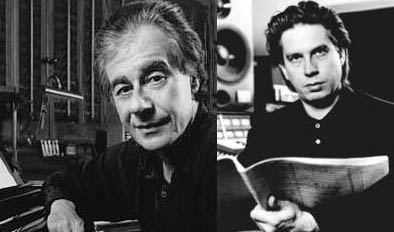
Though your local record store may have an expanded film section these days, the CDs contained therein have a shorter shelf life than most. So here are some I hope don’t pass you by. Danny Elfman, best known for punchy, sci-fi thrillers like Darkman, Batman, and Beetlejuice, got a chance to stretch out on Dolores Clairborne (Varese-Sarabande), a compositionally softer and more transparent score. “Composers are typecast just like actors,” comments Elfman. “Even though you try for some-thing different, you’re offered what you’re known for.”

Dolores Claiborne scored beautifully by Danny Elfman. Streaming on Amazon
Being so tied to the action of the medium, Elfman, like Bernard Hermann (Psycho, Citizen Kane), has made exquisite use of unique and often dissonant harmonies to create another level to the work. (Wayne Shorter admits to spending countless afternoons “absorbing” harmonies of horror and sci-fi epics). Working with smaller orchestras, Elfman divided the string section to mimic the different levels of emotion and interaction between the characters. “The challenge was the music which had to play all this relentless tension and tragedy and at the same time had to underplay this sweetness and a little girl’s innocence being corrupted.” The levels of subtlety in this eerie but beautiful score mark it as his best effort to date.

Shawshamk Redemption by Thomas Newman streaming for free on Amazon
Looking back 20 years to when I wrote this article, Shawshank Redemption (Epic), composed by Thomas Newman (Lost Boys, The Player) may be my favorite use of music in the movies. Shawshank is an unusually well-crafted score in which the composer mapped the internal emotion of characters through tasteful themes on the keyboard while creating string orchestrations of the biggest scenes. Newman, who received two Oscar nominations in ’94 (Little Women and Shawshank), is a member of film music’s most famous famiglia: composer-father Alfred Newman (Wuthering Heights), Hollywood’s only nine-time Oscar winner; Uncle Lionel (Hello, Dolly); brother David (Hoffa); and cousin Randy (The Natural). For the most personal scenes, the piano was often supplemented by the prepared pedal steel guitar of Chas Smith. “There’s a control and an ability to personalize you have with an altered instrument you could never have with a synth,” Newman points out.
Whether it’s the stark simple harmonies with the pedal steel’s echoes of eternity that accompany a prisoner’s dignified suicide, or the well-harnessed orchestral string hymns that accompany a prisoner’s taste and desire for freedom, it just seems to “fit.” Like the way an actor “fits” a part so well, you can’t imagine anyone else doing it, or any other way of having it done. “That’s what it’s all about, not overpowering or underpowering what’s on the screen,” says Newman. “It’s interactive. When Morgan Freeman has a big scene, even though you pull back on the string section, it’ll have more of an impact, because of his presence. Hearing the CD by itself, you get a different impression of the same scene. I imagine it is always a surprise.”
One of the year’s most moving scores, The Browning Version (Milan), belongs to Mark !sham. (As Elfman points out about trends in Hollywood scoring, “Besides the level at which the music track is mixed in, the present habit of pushing a certain range leaves the score sounding shrill, often disguising an entire range of subtlety in the strings.”) Though it was submerged in the movie’s original mix to the point of invisibility, the remixed CD has rescued Isham’s finest string work to date. The 20 cues on the CD, often of one or two minutes in length, never repeat the same instrumentation or same melodic fragment. This keeps the string arrangements constantly fresh. It takes a certain type of magic to keep you hungry for a theme each time it comes up.

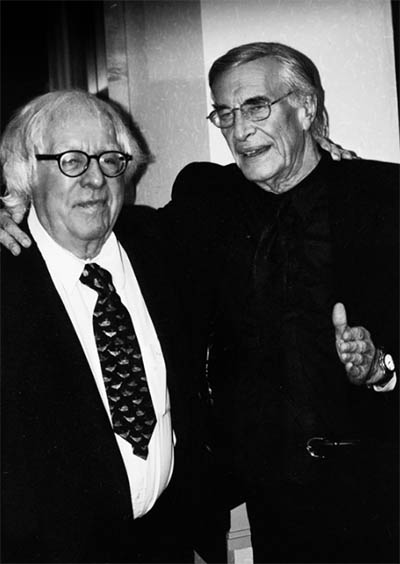
Photo by Bob Hershon